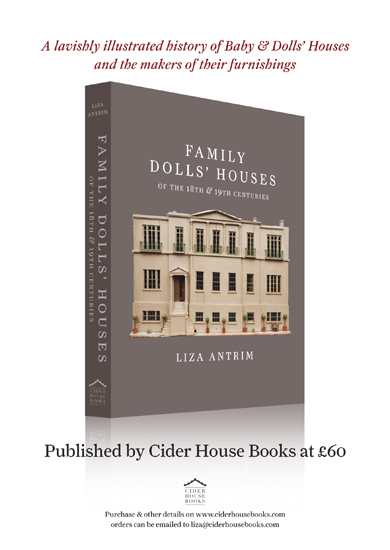
A Bit About the Book
This book is the culmination of 50 years of collecting, uncovering and restoring, mending and researching. I wanted to share the revelations and delight these wonderful houses have given me, and I hope in doing so also to find out more from the feedback of my readers. I can't describe the thrill of finding the name of a toy-man in a trade directory after you have been searching for it for years, with only a name or initials embossed on a grate, or printed on the back of a piano needle case to go by. I am still embarrassed recalling the looks I got in the Guildhall Library when I made my first discovery.
And then there is the excitement of revealing wallpapers which have been covered up for perhaps 150 years, and still look as fresh and vibrant as when they were new. This urge to restore has got me into trouble on not a few occasions, and my workshop still has several houses which are in need of much more attention than I had first realised. Hopefully, they will all get done one day.
However, the book has quite enough in it already, and I hope you will enjoy looking at my discoveries as much as I have done making them.
Still, perhaps I can mention just a few. The earliest was an 18th century toyman named John Henry Bielefeld who sold cast metal furniture and accessories, beautiful and fairly faithful reproductions of current fashion.
John Bubb was a wood joiner in the early 19th century producing furniture in his workshop in Bermondsy, which is authentic in style, if not perhaps the most sophisticated. He considerately stamped his name under each piece so we know exactly what he made.
Then there was the furniture made by the children from the Ragged Schools under the guidance of Octavia Hill, sold by the Ladies Guild under the label of "Art Toys".
The early 19th century also saw the rise of the firm of Evans & Cartwright, makers of tin toys in abundance in their Wolverhampton factory, "Whistle Hall". Like the Ladies Guild, they also employed child labour to produce their wares.
Last but not least are the plants made by Beatrice Hindley, gardener to Royalty, who fashioned beautiful creations from metal and planted them in highly decorative wooden pots. The most recent discovery of these was in a cup found in the bottom of a box of china bought at an auction. There's always hope of a new discovery, even in the most unlikely places!
Some readers' comments.
"Hello Liza!!
Hope you are finally getting some peace of mind after all the pressures of getting your book to us! I genuinely feel this is the best source book we've had on antique dolls houses and furnishings since Vivien Greene, and in many ways, surpasses her books. It certainly fills an enormous gap in knowledge .Your scholarship over so many years is tremendous.Your clear and friendly style of writing is so pleasurable to read and perhaps belies the years of hard work and experience behind it all. Maybe your book marks a coming of age for our hobby and passion; it completes the circle begun by enthusiasts like Vivien Greene and Flora Gill Jacobs. [You have written the book that they would have liked to read!] For the rest of us who love collecting and furnishing antique houses,your book is a landmark. Thank you!" Marel.
"I did speak to Rita Reeves recently and asked her "what's it like .....is it beautiful".... Rita paused and just said "it's what we've been waiting for". Nick.
"Superb book Liza, I spent the whole of yesterday evening transfixed by it, wonderful photography, and so much information to absorb. Looking forward to long evenings in front of the fire now, curled up with the book. I am so enjoying it, no work is being done! There is so much detail in the book, exactly what you want to know, often missing from and glossed over in other books, I have identified items I have been trying to find out about for ages, fabulous, thank you so much Liza." Barbara
"I finally got around to sitting in what's expected to be the last of the summer sun after work today to open your book. The photography is excellent, there is so much to take in and I just know I will be referring to it and looking through it time and time again. Thank you for writing it. I would recommend anyone who is interested in old houses and contents buys it. Having had a quick look to see if I owned anything remotely that's listed in the book I found I did. I own maybe a couple of the things shown in it--some kaybot foods. Well you have to start somewhere don't you. Maybe if I delve further I may be lucky to find something else (or not). Seriously though, its a brilliant book." Alicia
"My dear, it is simply breath-taking, both to read, and to look at!
You and your "design team" should be enormously proud! The book
is so beautifully "laid out", with such lovely and thorough pictures of each
house, its interior and contents, that one almost feels one is standing before
each one, and that you are giving each of your readers a "private tour", as it
were, of each house and its contents, and at the same time giving a complete
history of the evolution of the English Dolls' House, and of the uniquely English
furniture that was made for it, over the past 2 1/2 centuries. Add to that, that
the book is beautifully written, with great humor and charm. I adored the story
of Rachel's "discovering" for the first time, the Evans and Cartwright name on
the back of a chair leg, after you had bought a "lot" of E & C pieces at auction.
(If only we all had such clever and attentive daughters!)
But what makes the book unique, I think, is your thorough and brilliant research
into the furnishings and decorative accessories to be found in the houses, giving
such a wonderful overview of the "toy trade" in 18th and 19th Century England, as well. That you so thoroughly "educate" the reader on all of the serious collector's
"favorite" antique English miniature furniture and chattels, like that of "Bubb", "E & C", "The Ladies' Guild", "Bielefeld", etc, so that the reader can really comprehend
how rare, special, and charming these tiny masterworks are, is a brilliant accomplishment, and makes "Family Dolls' Houses" a truly great and comprehensive work. I was particularly taken with the chapter on "Bielefeld" items, having admired
these items in friends' collections in the UK, and in the Vickerman House, and in
Flora Jacobs' "Marshall Collection" in the US, and always wondered WHO made them. They always seemed quintessentially English to me, as they always appeared derived from English sources and designs, and to be found in late Georgian/Regency
dolls' houses or collections, so it is such a delight to know, finally,-- thanks to you!--
something of their history, and of the period in which they were made, etc. Truly wonderful!
"Family Dolls' Houses" is, simply, a remarkable achievement, and will no doubt set
the standard for dolls' house appreciation and scholarship, for many years to come. I
really do feel that you have written a new "classic", Liza dear, which WILL be the
definitive work on antique English Dolls' Houses for the next several decades. You
have brought a collector's passion, a conservators' skill, and a curator's exceptional
knowledge, to the serious study of English dolls' houses into the 21st century, and
your book is for our time what Vivien's books were for the second half of the 20th Century!
I really do think that Vivien would have wept tears of joy over this book, and
cheered! (I am sure she and Flora Jacobs are merrily discussing it, up in dolls' house
heaven!) It seems to me, that in honoring Vivien's memory, and acknowledging her
great legacy in the field of dolls' houses and their appreciation, that you have created
your own great legacy in this arena -- one which fellow collectors will be looking to
and venerating for many years hence." Alec
One of the Guardian Readers' books of the year.
Cider House Books © 2010 |